The High Cost of Cheap Code: Why Your "Frankenstein" Codebase is Unmaintainable
You look at your product’s codebase and you don’t recognize it.
It was built quickly. You hired three different top-rated freelancers from a popular platform over the last year. They were affordable and available immediately.
At first, features shipped fast.
Now, development has ground to a halt.
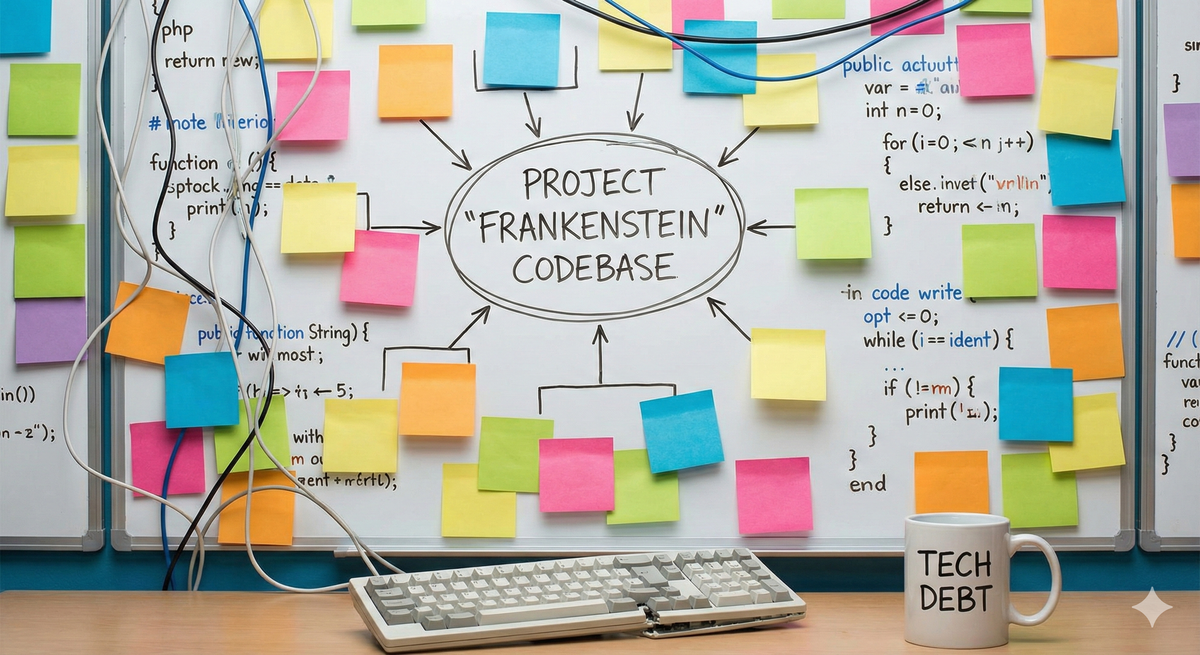
Your codebase has become a graveyard of half-finished ideas and conflicting architectural styles. It is a "Frankenstein" product—cobbled together with no central nervous system.
This isn't bad luck. It is the inevitable outcome of the gig economy model applied to complex software engineering.
When you hire disconnected individuals instead of a cohesive team, you are buying technical debt on an installment plan.
Here is the reality of what happens when there is no unifying engineering leadership.
The hidden costs of the freelancer model
You didn't hire bad developers. You likely hired smart people who were optimizing for the wrong thing.
A transient freelancer optimizes for speed and ticket completion. They rarely optimize for long-term maintainability or how their code interacts with the module built by the guy you fired last month.
Without a dedicated Engineering Manager or Lead Architect, you face severe compounding risks:
- Velocity crashes: Every new feature breaks two existing ones. Your current team spends 80% of their time fighting fires instead of building value.
- Dangerous knowledge silos: If "Freelancer A" leaves, nobody else understands the payments module. Zero documentation means zero handover. You are held hostage by bad code.
- Financial bleed: You are paying senior rates for junior output because senior devs are stuck untangling spaghetti code. We often see refactoring costing 3x more than building it correctly the first time.
- Unscalable architecture: The tech stack is a random assortment of whatever tools each freelancer preferred at the time. It won't handle 10x user growth.
How to stabilize a failing codebase
If this sounds familiar, you need a rescue mission.
You have to stop hiring individual ticket-takers and start building an actual engineering function. You don't need more hands on keyboards right now. You need a brain.
Here is the playbook for turning a chaotic codebase into a sustainable product:
- Perform a merciless audit: Stop building new features immediately. Bring in a senior architect to assess the damage. Identify security risks, performance bottlenecks, and architectural dead ends.
- Install central leadership: This is non-negotiable. You need a Lead Developer or a Fractional Engineering Manager (EM). Someone must own the "how." They set the standards and enforce the vision.
- Standardize the workflow: No more pushing directly to the main branch. Implement mandatory Pull Request (PR) reviews. Set up automated testing (CI/CD). Enforce strict linting rules so everyone's code looks the same.
- Pay down debt systematically: Don't try to rewrite everything at once. Dedicate 20-30% of every sprint to refactoring the ugliest parts of the system while slowly delivering new value.
A real-world rescue
We recently took over a logistics platform built by five disjointed freelancers over two years.
The deployment process took four hours and frequently crashed production. The founders were terrified to touch the code.
We replaced the five freelancers with a managed pod: two senior full-stack developers and one part-time Engineering Manager.
We standardized their deployment pipeline and introduced rigorous testing.
In the first 90 days, we reduced deployment time to 15 minutes. More importantly, shipping velocity for new features doubled because the devs weren't afraid of breaking the system with every commit.
Cheap initial development is usually the most expensive mistake a founder makes.
Don't build a graveyard.
If your codebase feels like a trap, let’s talk about an audit.